skip to main |
skip to sidebar
(Image by SHP)
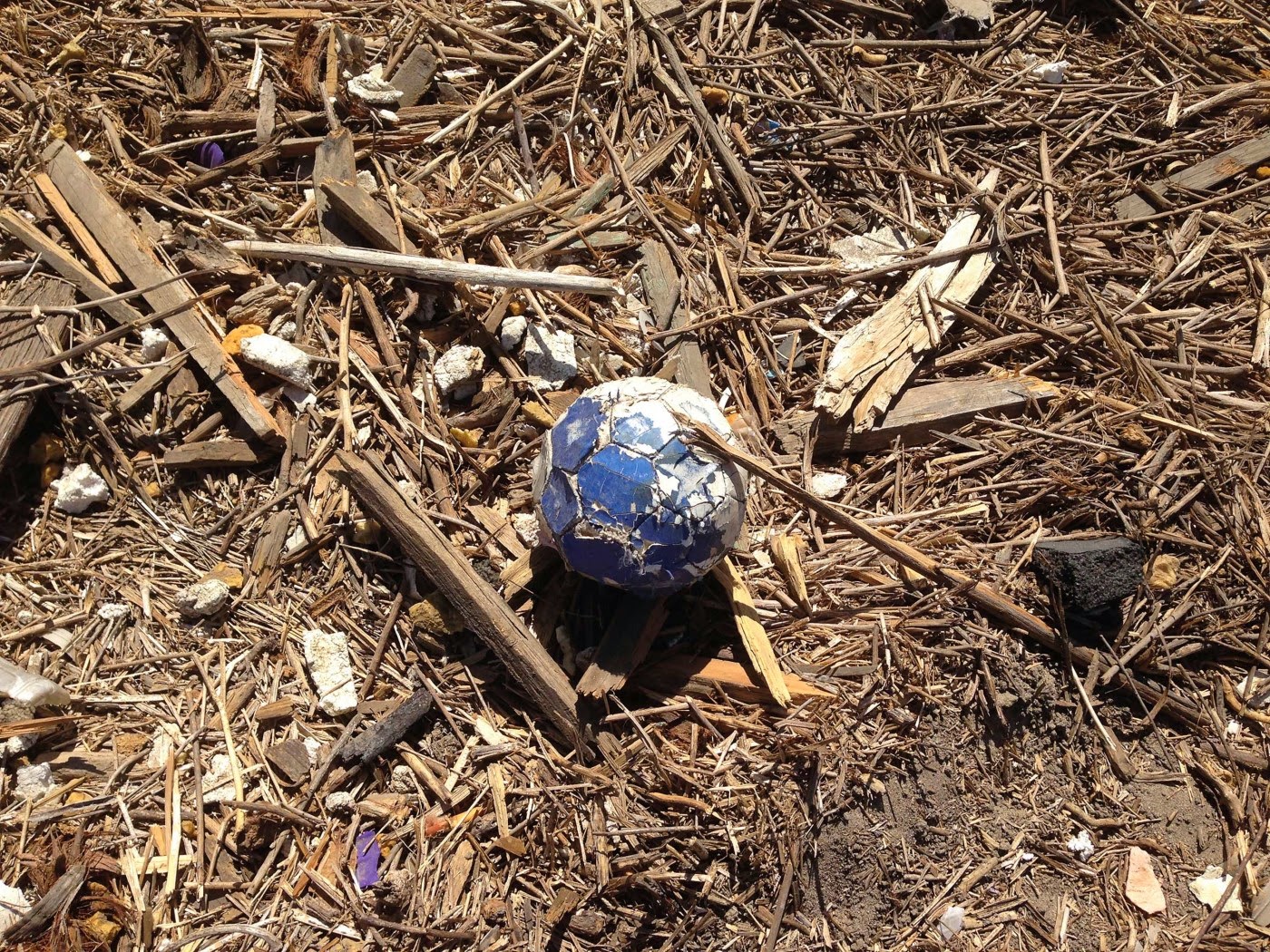
Chapel Hill-based photographer Susan Harbage Page has been photographing along the border between the USA and Mexico since 2007, producing award-winning work that attends to signs of the transition in personal identity from one culture and nation to another by documenting the personal things left behind as people make that transition.
(Image by SHP)
Page photographs the objects where she finds them, then removes the objects from that setting and brings them to our attention by caring for them and exhibiting them as though they were objects of value in a museum collection rather than an item of ephemera cast aside as need dictated to the original owner.
(Image by SHP)
Page has exhibited this work widely over the past several years, in gallery and museum settings as well as in Installations in public spaces, contributing to our understanding of the experience of transition gone through by people whose emigration to the American South is transforming our culture.
(Image by SHP)
Page's work has been exhibited nationally and internationally, and has been recognized by awards and grants to support her continued efforts to bring attention to the scandal of America's immigration policy and to the people who give up their identities and assume new ones in their efforts to find a safe and secure place to do their work and live their lives with dignity.
(Image by RM)
Now, it turns out, the distinguished American photographer Richard Misrach (see image above) has recently produced a body of work in which he photographs along the border between the USA and Mexico, attending to signs of the transition in
personal identity from one culture and nation to another by documenting
the personal things left behind as people make that transition.
(Image by RM)
Misrach photographs
the objects where he finds them, then removes the objects from that
setting and brings them to our attention by caring for them and
turning at least some of them over to a musician named Guillermo Galindo, who turns these items into musical instruments.
(Image by RM)
Misrach them photographs them again as objects that engage us as objects of value in a museum
collection rather than an item of ephemera cast aside as need dictated
to the original owner.
You can read more about Misrach's work here, from the California Sunday Magazine, and here, from a story from National Public Radio, where we learn that Misrach's work will be on display at the San Jose Museum of Art in the spring of 2016.
(Image by SHP)
The confluence of these two projects raises for us as photographers and artists a number of questions, it seems to me.
I've deliberately copied my language in this account of two artists' work to highlight the similarities between them in subject matter, concept, and execution, a similarity that extends to specific images, such as Page's image, above, of tires linked together and covered with dust and Misrach's image, below, of tires linked together and covered with dust.
(Image by RM)
Or, of Page's image of a fence separating the USA from Mexico, below, or Misrach's image of a fence separating the USA from Mexico, below Page's image.
Not to mention their photographs of combs abandoned at the border, see above.
(Image by SHP)
In my regular
line of work, which is about studying the history and interpretation of literature and
culture, we look for traces of artistic development, noticing signs
of influence and response among writers and artists as careers in the
arts unfold.
(Image by RM)
In my field, we recognize borrowing and indebtedness as well as the extent of transformation as one artist draws on the work of another artist in a variety of ways.
In my field, we also practice a discipline which recognizes that while there are an endless array of possible ways of approaching and interpreting the subject of our study, we always build on the work of others, and always acknowledge our sources, models, and other kinds of indebtedness to those who have preceded us in our common pursuit of understanding, enabling and inspiring our own endeavors.
I'm wondering to what extent issues like these are relevant to the relationship between living artists today working in a field in which originality is highly valued, but in which appropriation of another artist's work can in itself be regarded as an expression of creativity.
So, our question for the day -- what does Richard Misrach owe Susan Harbage Page?
Royalties, perhaps, for replicating her ideas, methods of working, and types and kinds of images? Or at least an acknowledgement of his indebtedness to her?
Does their common agenda make their work complimentary or does it make Misrach's work derivative?
Does Misrach's work constitute a case of plagiarism? Or does our understanding of artistic creativity privilege the individual vision so much that such considerations are irrelevant?
Does it matter that Misrach, with a much higher profile in the world of photo culture, gets national media attention for work that clearly replicates Page's work, in spite of Page's award-winning recognition for her work in North Carolina and the Southeast?
Questions to ponder -- I hope to provoke some conversation. Feel free to join in.
Page makes a self-portrait each year she works on the border, showing her against the Fence in silent protest of America's immigration policy.
Here is this year's photograph.
(Image by SHP)
Seems to me, this year, Page has even more to protest about than she's had in previous years. And this time, its personal.
Work from Nashville-based photographer Tamara Reynolds' Southern Route portfolio was featured in the New York Times' Lens blog in late November, go here.
This is Reynolds' second appearance in the NY Times this year, the other coming back in June, go here.
I think Reynolds is one of the finest photographers working in the South today, so this recognition from the NY Times is richly deserved.
In addition, Columbia, SC-based photographer Kathleen Robbins, another of the finest photographers working in the South today, was featured in an interview with Eliza Bourne, managing editor of the Oxford American, and you can read that interview here.
Terri Garland, another fine Southern photographer, published a portfolio of her work called Louisiana Purchased, in the Oxford American, and you can see it here.
Other Southern photographers featured recently in the news include the following photographers recognized by Jeff Rich through inclusion in his Eyes on the South feature of the Oxford American, since we last checked:
Brant Barrett, Fred Hirschman, Cody Cobb, Michael Clausen, Dennis Church, Marcie Hancock, Lara Shipley, Antone Dolezal, Carey Gough, Adam Forrester, Missy Prince, and Johnathon Kelso.
And, last but not least, Eliot Dudik's show at the Morris Museum of Art in Augusta, GA, with work from his Broken Land portfolio, has been extended beyond its original mid-December closing date, so you wtill have time to get over to Augusta and see this fine work.
Honorary Southern Photographer Eugene Richards had to fund the publication of his most recent book through a Kickstarter campaign, but Red Ball of a Sun Slipping Down is beginning to show up on multiple lists of the best photography books of 2014.
The New York Times lists it here, Time lists it here, the Wall Street Journal lists it here, and I have a feeling this powerful book will show up on more such lists as the end of the year approaches.
In the meantime, other Southern photographers have new books, or books in process.
Laura Noel has started her own publishing company, called All's Fair Press, and its off to a booming start.
Her books Withdrawn and All's Fair Volume One were selected to be part of the Filter Photo Festival in Chicago, September 24-28, 2014.
Others of her books, Law & Order Gets Me Through the Night and Killing the Day, Volumes 1-4 were selected for the InFocus Juried Exhibition of Self-Published Photo Books, held at the Phoenix Art Museum Gallery for the Center for Creative Photography, August 23- September 28, 2014.
Some books to look forward to:
Kathleen Robbins' forthcoming book Into the Flat Land has already been announced and will be out in January.
Lori Vrba will publish her book The Moth Wing Diaries with Daylight Books in the spring of 2015.
And I am sure there are others -- if folks will let me know their plans and publication schedules, I'll add them to this list.
 San Francisco-based (but deeply rooted in the American South) photographer Elizabeth Moran is giving a literal spin to the old metaphor that the American South is haunted.
Her portfolio Record of Cherry Road, now on exhibit at the Gulf and Western Gallery at New York University through January 17th, 2015, in Moran's words, "investigates the myths that surround my family's home, the farmhouse of an old plantation in Memphis, Tennessee," on Cherry Road.
More on this exhibition here.
Moran explains the background of her project thus: "Storied to be haunted, the house contains a multitude of histories that are ever-present yet hidden. With the help of my aunt and uncle, both paranormal investigators, the project seeks a presence that exists within familial lore.
San Francisco-based (but deeply rooted in the American South) photographer Elizabeth Moran is giving a literal spin to the old metaphor that the American South is haunted.
Her portfolio Record of Cherry Road, now on exhibit at the Gulf and Western Gallery at New York University through January 17th, 2015, in Moran's words, "investigates the myths that surround my family's home, the farmhouse of an old plantation in Memphis, Tennessee," on Cherry Road.
More on this exhibition here.
Moran explains the background of her project thus: "Storied to be haunted, the house contains a multitude of histories that are ever-present yet hidden. With the help of my aunt and uncle, both paranormal investigators, the project seeks a presence that exists within familial lore."
Moran says that her work explores "my family’s own haunting as the dead continue to live through the recurrence of names, like George and Cary, through multiple generations.
Moran expands on the concept of haunting: "With my given name, Elizabeth Cary, I continue the Record of Cherry Road that another Cary began during her time in Memphis in the 1960s. The city itself, with its conflicting landmarks of Egyptian pyramids and Christian crosses, remains haunted by its own troubled past."
Moran links her work to "Documentation of paranormal activity from my mother’s childhood, like a map of footsteps or a flash in a window, {that] further conflate myth and history."
She notes links between "spirit photography from the nineteenth century, when ectoplasm was made of cotton" and the traces of cotton crops that haunt Southern fields, as well as "contemporary images of the paranormal, where chromatic aberrations are not just an artifact of a digital sensor, the project questions our continued reliance on photography to prove a belief."
Moran's work is getting a significant amount of attention, featured in Lenscratch last summer and more recently in the New Yorker in connection with the show at New York University.
The New York TImes has also featured it, as has Wired and the Don/Dean Photogaphy blog, here.
I must say that I am not generally a fan of conceptual photography in which the idea that unites a collection of otherwise disparate images seems contrived or artificial, especially when the images that are informed by the idea are not compelling or engaging on their own.
Moran's work, however, does stand on its own. In addition, the interaction here between the various meanings of "haunting" and the personal histories of Moran's engagement through photography with her own history and sense of place and culture earn for this work all the good recognition it is now receiving.
Good photography complicates and deepens our relationship to the world we ordinarily inhabit. I have a feeling that after seeing Moran's work, I will sense just a bit of a chill when I see some of those features of the Southern landscape we usually take for granted.
Good to be reminded of the generations that have gone before us, and of the ways their continued presence abides among us. Maybe that is a characteristic of Southern photography, more generally considered.
Nancy McCrary and all the good folks at South x Southeast Photo Magazine (SxSE) have now brought us S[x]SE for November/December 2014.
This issue offers lots of fine work that gives us much to contemplate in this season when, as the song goes, it is time for us to stand and watch the seasons turn.
Much of this issue is given over to a series of interviews, including Jennifer Shaw's conversation with Judy Sherrod about PhotoNOLA 2014, and about life on New Orleans.
Also included are three interviews that Jerry Atnip conducted for S[x]SE, one with Jack Spencer (see image above) on his new work, another with Alan Rothschild on the Do Good Fund for Southern Photography, and another with the good folks at Digital Arts Atlanta.
This issue also features Lorrie Dallek's portfolio of work made on tobacco farms in Cuba -- interesting to see how tobacco looks growing in another country.
Also included are portfolios of work by winners in this year's competition sponsored by the Arts Clayton Gallery, a non-profit community art gallery in Clayton, GA.
The winners include Tricia Sterns (see image directly above), Marla Puziss (see image directly below), and Donna Thompson (see image below Puziss' image).
And you can have access to all this fine -- and award-winning -- work for a very reasonable fee.
You can subscribe to the online version here.
Don't put it off any longer.
You know you should subscribe.
You know it, you really do.




 Posts
Posts


