Tuesday, April 20, 2021

Carrie Mae Weems at the Nasher Museum in Durham


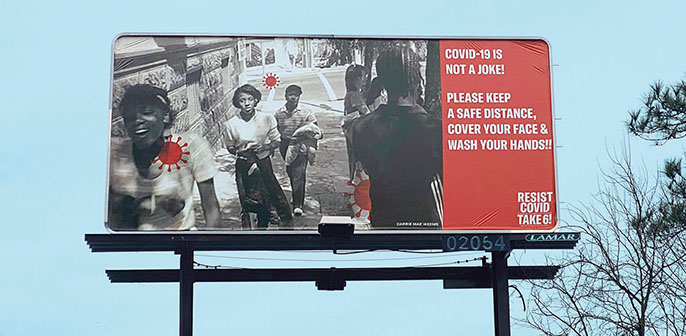
Honorary Southern Photographer Carrie Mae Weems (see image above) is having a major show of her work in Durham, NC, made possible by Duke University's Nasher Museum. Weems' work is visible all over Durham, on billboards in a lot of locations. 

Marshall Price, the Nancy A. Nasher and David J. Haemisegger Curator of modern and contemporary art at the Nasher explains:

 “It kind of fell in our laps,” he says. Artist and MacArthur grant-winner Carrie Mae Weems, a Black woman whose art is in the Nasher’s collection and who has collaborated before with the museum, had created an outdoor public art installation during a Syracuse residency, and she was spreading it out to museums in places like Philadelphia, Chicago, and Nashville, Tennessee. Did the Nasher want to participate?

“We felt like it was a really great opportunity,” Price says. “We kind of rolled up our sleeves and got to work.”

"Weems’ work, called Resist Covid/Take 6!, exists completely outdoors, largely as public-service announcements and statements of encouragement about surviving COVID. “Don’t worry, we’ll hold hands again,” reads the caption of an enormous banner hanging on the outside of the Nasher, showing a row of people holding hands. Says one of a series of banners on Campus Drive lampposts: “Because of inequity, Black, Brown & Native people have been the most impacted by COVID-19. This must be changed!” Other banners and window clings thank frontline workers and remind people to practice social distancing. They show up on building sides and in windows all over Duke—on the Rubenstein Arts Center, on the gates to the (currently closed) Duke Gardens.

"The signs show up all over Durham, too, from billboards to the windows of community partners like the American Dance Festival headquarters. Part of Weems’ design of the installation was that community collaboration. “It functions in that context just as much as a public-service announcement as art,” Price says. None of the posters have Duke or Nasher branding. The point is to get people talking about how to respond to COVID; how it’s affecting them and their community; how Black, brown, and native populations are being especially hard hit."

The above quotes are from a story in the Duke Alumni Magazine; read more if you go here:

https://alumni.duke.edu/magazine/articles/art-nasher-time-covid

Monday, April 12, 2021

Southern Photographers Sweep Top Awards in LensCulture's Annual Competiton


LensCulture has released the results of its annual art photography competition.  

In first place in the Series Competition is a set of images (see image above) by Richmond, VA-based photographer Susan Worsham, from her Bittersweet on Bostwick Lane portfolio.


In first place in the Individual Image competition is "The Clouds Whispered Your Name" (see image above) by Washington DC-based photographer Tavon Taylor.

There was clearly something about subjects shirtless and lying down that appealed to this year's jurors. Fine work, though! 


Among photographs singled out for special recognition by the competition's jurors is the image above by Houston-based photographer Karen Navarro

The Importance of Photography for the American South


Grace Elizabeth Hale, who is the Commonwealth Professor of American Studies and History at the University of Virginia, has written a first-class article entitled "Photograph as History in the US South," in Southern Cultures, the quarterly publication of the Center for the Study of the American South, at UNC-Chapel Hill.  

Hale points out that while "We understand the South as a major site of U.S. history, a landscape littered with evidence of the past, from plantation slavery and the Civil War to the Civil Rights Movement. What fewer people know is that the region is also an essential location in the history of photography. 

She goes on:

For photographers making work in the world rather than the studio, the South has been a rich place to make images. At odds with the grand story of America as expanding freedoms, the region has been understood as both the national reservoir of cultural authenticity and the national cesspool of white supremacy. The contradictions give artists a lot to look at. 

An admittedly partial list of photographers who have done important work in and about the U.S. South might start with Doris Ulmann and Walker Evans, Marion Post Wolcott and Arthur Rothstein, Clarence John Laughlin and Ralph Meatyard, Eudora Welty and Gordon Parks, Emmet Gowin and William Christenberry, William Eggleston and Dawoud Bey, Sally Mann and Carrie Mae Weems, Deborah Luster and Susan Lipper.

In much of this work, artists render the forms of history visible by returning to photograph the same place, people, or subjects at different times. They restage old images or revisit places photographed by others. They employ old photographic processes, formats, and materials. And they consciously go back to former histories, to older Souths and to the relationships people have constructed with these pasts. 

In their work, return as a practice, a process, a subject, and an aesthetic structures time and, in this way, marks and makes history. How we understand and give form and meaning to change over time becomes as much the subject of this work as what exists on the other side of the lens.

There is much more to learn from Hale's essay, and you can read it here: 

https://www.southerncultures.org/article/signs-of-return/


Wednesday, October 21, 2020

Dawoud Bey Named "One of the Greats"

Honorary Southern Photographer Dawoud Bey has been named "One of the Greats" by the New York Times, go here

The Times celebrates Bey and four other contemporary artists as "talents who, in mastering their crafts, have changed their fields — and the culture at large."

Bey is celebrated in the essay as an artist who "In the seemingly simple gesture of photographing Black subjects in everyday life, . . .  helped to introduce Blackness in the context of fine art long before it was trendy, or even accepted." 

This celebration of Bey's singular achievement in his career so far follows up on an earlier Times essay on Bey from 2018, go here

Bey was awarded a McArthur Fellowship in 2017, which led to this essay in the Washington Post, worth reading for an overview of Bey's illustrious career.

Bey has photographed in the American South as well as in Harlem and other locations. We featured him and his work in 2011 when he had a major show of work up at Emory University in Atlanta, go here.

Here is an image from that show, also featured in the 2018 Times essay.

Incidentally, the photographs of Bey in the NY Times article were made by another Honorary Southern Photographer, Latoya Ruby Frazier. 

Congratulations to Bey for this exceptionally well-deserved recognition!

Tuesday, September 10, 2019

Robert Frank dead at 94


The distinguished photographer Robert Frank has died at the age of 94. 

For the New York Times obituary, go here. For the Washington Post, go here. For the Guardian, go here.


Frank's early images, published in his landmark book The Americans, helped shape generations of photographic work in the American South, both in terms of technique, style, and subject matter. 


Only the work of Depression-era photographers like Walker Evans, Dorothea Lange, and Marion Post Wolcott rivals Frank's in this regard.


The International Center of Photography's website has a helpful overview of Frank's career, go here.


Lens Culture weighs in here.  


Wednesday, September 4, 2019

SOUTHBOUND now in Raleigh and Durham through December 2019


Southbound

SOUTHBOUND, The epic show of contemporary Southern photography, is opening this month in North Carolina, at two venues. 

Part of the show opens on September 5th, with a reception between 6-8 pm, at the Gregg Museum of Art + Design in Raleigh, off Hillsborough Street, on the campus of NC State University.

The other part of the show opens the next day, September 6th, with a reception between 6-9 pm at the Power Plant Gallery, in downtown Durham, in the American Tobacco Campus near the Durham Bulls Athletic Park.


Both venues will have this work on display through December 2019. 


The full title of this show is Southbound: Photographs of and about the New South. The show was originally put together by Mark Sloan and Mark Long of the Halsey Institute of Contemporary Art at the College of Charleston School of the Arts.


The show includes images by fifty-six photographers now either living or working in the South. According to the organizers, the show seeks to explore "the storied, charged, and enduring place that we call the South."

This show is not to be missed. The large number of photographers with work on view, as well as the range and diversity of their visions of the South, make this show as complete and as thorough an envisioning of the South as we are likely to get for some time to come. 

One could easily think of others whose work is as deserving of inclusion as the work included here, but that is the case, regardless of how large the show might be. Such is the happy state of photography in the American South in this second decade of the 21st century. 

The show was up in Charleston last year, and now travels to North Carolina, where it has been rearranged by author and North Carolina native Randall Kenan into two separate but related interrelated exhibitions: Flux: Nostalgia vs. the Future, on view at the Power House in Durham, and Home: How We Make Ourselves, on view at the Gregg Museum of Art + Design at NC State University. 
 

The organizers of this rendition say the purpose of the show is "to engage with the South through the eyes and minds of fine art and documentary photographers working in the region since the year 2000, a time when, for all the overlapping processes of economic, demographic, social, and cultural change, it makes sense to think about a New South. 

"The photographs that result from the artists’ sustained thinking about, looking at, and discovery of the multifaceted and startling New South speak to the history, complexity, and ongoing transformation of the region. 

"The images represent the photographers’ own considered responses to their chosen environ­ments–no photographs were commissioned for the project. The Southbound photographs provide the viewer with shifting pathways to moments of unbridled joy and deep frustration, and, ultimately, to an understanding, however fleeting, of this place.

"While the South represents too many things to too many people ever to be condensed into any one medium–literary, cartographic, scholarly, or photographic–Southbound opens windows onto the region. The photographs presented here underscore the resilience of the South even as they reveal it as a place remade, once again, in the early twenty-first century."

To learn more about this show, go to the Southbound website, southboundproject.org, which serves as an archive for the show and includes all the 550 images from the fifty-six participating artists.

There are also lots of ancillary events going on while this work is on view in Raleigh and Durham. For a calendar of the events in Durham, go here to the events page for the Power Plant Gallery. Events held at the Gregg Museum can be found on the Gregg's website.

Click here to download a pdf copy of the works on view at the Power Plant Gallery.
Click here to download a pdf copy of the works on view at the Gregg.

And make your plans to see SOUTHBOUND at these two venues. This is the REAL DEAL, the BIG DEAL, the REALLY IMPORTANT show you must see if you care anything at all about the quality of photography in the American South today.

Thursday, May 30, 2019

The History of Southern Photography


There is a very fine article on the history of photography, and the history of the South,  available from the fine journal Southern Cultures, here.

The title of the article is "Photography as History in the U.S. South," and the author is Grace Elizabeth Hale, who is Commonwealth Professor of American Studies and History at the University of Virginia and a 2018–2019 Carnegie Fellow.

She says, of her subject:

"We understand the South as a major site of U.S. history, a landscape littered with evidence of the past, from plantation slavery and the Civil War to the Civil Rights Movement. 

"What fewer people know is that the region is also an essential location in the history of photography. 

"For photographers making work in the world rather than the studio, the South has been a rich place to make images. 

"At odds with the grand story of America as expanding freedoms, the region has been understood as both the national reservoir of cultural authenticity and the national cesspool of white supremacy. 

"The contradictions [have given] artists a lot to look at . . . . . 

"[Parts of the rural South] became de facto open-air museums where poverty, vernacular culture, and a material sense of the past in the present seemed to be permanently on display, even if as time went on you had to crop the Dollar General out of the frame.”

Hales mainly talks about the work of Emmet Gowin, William Christenberry, and Sally Mann, but the ideas she works with are worthy of consideration for a whole wide range of photographers. 

This piece is must reading for anyone who photographs, or who values life, in the South.

Tuesday, December 18, 2018

Christmas at Graceland -- December 2018


In the words of Paul Simon, "I have reason to believe we all shall be received in Graceland."

Best wishes for a joyous holiday season to Southern photographers and Southern photography fans everywhere. 

Thank you for your interest in The Southern Photographer, and especially for your kind words of support for this blog during the past year. 

I especially appreciate your patience with me during my Sabbatical. We are back now, with what I hope is a sustainable practice. 

So I know I'm a bit behind right now in chronicling the world of fine art photography in the American South. 

Nevertheless, the Southern Photographer must now take a short break, while yr humble blogger attends to other professional and personal responsibilities.


We look forward to resuming our chronicle after the 1st of January 2019

In the meanwhile, remember that Christmas is a season, not just a day, and the season of Christmas is 12 days long.  

So its Christmas from the eve of December 25th of 2018 all the way through until Twelfth Night, January 5th, 2019. 


Graceland, of course, the home of Elvis, who became famous by appropriating the music of Arthur Crudup and Big Mama Thornton. They wrote the music, and he made the money.  

But what he spent it on was this tacky McMansion in Memphis. 

That's one of the things I believe about the South -- it can set you free and break your heart, all at the same time. 

Happy holidays, everyone!

Southern Photography at the Nasher


The Nasher Museum at Duke University has up an important show of Southern photography entitled Across County Lines: Contemporary Photography from the Piedmont.

While concentrating on photographers who live and work chiefly in Piedmont North Carolina, the show demonstrates the diversity of subjects, styles, and interests of several generations of Southern photographers. 

 
 Photographers in the show include Ben Alper, D.L. Anderson, Bill Bamberger (see image directly above), Endia Beal,  Diego Camposeco (see image below), Aaron Canipe, Kennedi Carter, Faith Couch, Phyllis Dooney, Tim Duffy, William Ferris, Maya Freelon, Tamika Galanis, Michael Galinksy, Alex Harris, Harrison Haynes, Titus Brooks Heagins (see image at the top of this blog post), Colby Katz, Anna Kipervaser and On Look Films, Jeremy M. Lange, Bryce Lankard, Jim Lee, Elizabeth Matheson, Lisa McCarty, Lindsay Metivier, Susan Harbage Page, Tom Rankin, John Rosenthal, Margaret Sartor, MJ Sharp, Christopher Sims, Heather Evans Smith, Leah Sobsey and Tim Telkamp, Hồng-Ă‚n Trương and Hương NgĂ´, Burk Uzzle, Caroline Hickman Vaughan, and Gesche WĂĽrfel.

 
This show is up through February 10th, 2019. It's very worth your while to make the journey. 
 

Wednesday, December 5, 2018

PhotoNOLA for 2018


PhotoNOLA, the annual photography festival in New Orleans, this year runs from  December will bring us  this year running from December 12th-15th, 2018. 

For the full calendar of events for this year's festival, go here.

A special feature of this year's festival is the show now up at the Ogden Museum, entitled New Southern Photography, featuring the work made in the past 10 years by 25 photographers, many of whom are familiar to readers of this blog. 

 
The photographers chosen for this show include David Emitt Adams, Kael Alford (see image above), Elizabeth Bick, Christa Blackwood, John Chiara, Scott Dalton, Joshua Gibson, Maury Gortemiller, Alex Grabiec, Aaron Hardin, Courtney Johnson, Tommy Kha, Brittany Lauback, Carl Martin, Jonathan Traviesa & Cristina Molina, Andrew Moore, Celestia Morgan, Nancy Newberry, RaMell Ross, Whitten Sabbatini, Jared Soares, Louviere + Vanessa and Susan Worsham (see image below). 


According to the folks at the Ogden, "New Southern Photography explores the role photography plays in formulating the visual iconography of the modern New South."

They go on: "Regional identity in an interconnected and global world is central to the exhibition’s narrative. 

"Themes and ideas addressed in New Southern Photography include: memory, the experience of place in the American South, cultural mythology and reality, deep familial connections to the land, the tension between the past and present, and the transitory nature of change in the New South." 

If you can't make it to PhotoNOLA this year, the show at the Ogden is up through March 19th, 2019. 

Tuesday, November 27, 2018


SOUTHBOUND: Photographs of and about the New South, the show now up at the Ogden Museum of Southern Art in Charleston, SC, has received appreciative coverage from the New York Times, go here.

The Times story features a number of images from this show, including Blizz and Brooke by Jares Soares (see image above). 

The story argues that "Accepting the South for what it is, instead of what we imagine it to be, is not easy. “I think that if you were to Google ‘Southern photography,’ you’re going to come up with the images of a rusted pickup truck in a field,” Richard McCabe said. “But the South is as much Houston as it is the Mississippi Delta. I think what we don’t realize is the place is just as connected as everywhere else.”
It goes on: “New Southern Photography” . . .  challenges the outdated assumption that the South is disconnected and isolated. Many people have tried to create a new visual language for the South, only to fail because they’d presumed there was a singular, representational way to do that. Mr. McCabe, who is the museum’s curator of photography, didn’t make the same mistake.
“‘New Southern Photography’ is not intended to define the South,” Mr. McCabe wrote in the exhibit’s catalog, “but rather to create an open discussion.”

And so it will.  

The Times article also brings to my attention a new book by historian Scott L. Matthews, Capturing the South: Imagining America’s Most Documented Region,” which examines documentary work of the South throughout the 20th century.

Matthews is quoted in the Times piece as arguing “that as early as the 19th century, portions of the South — particularly the rural South and what was almost considered the West at that time, but what we would now think of the Deep South — became this frontier culture that stood in stark contrast to the rapidly-modernizing cities of eastern America, that were not only becoming industrialized, but beginning to experience rapid immigration from Europe.”  The South remained true to itself while “emerging markets were standardizing the rest of America. 
 This book will be on my wish list for Christmas, for sure.


Wednesday, November 7, 2018

Southbound in Charleston


The Halsey Institute has on exhibit at the Ogden Museum of Southern Art and City Gallery at Waterfront Park, both in Charleston, SC, a new and exceptional show of Southern photography called SOUTHBOUND: Photographs of and about the New South, through March 2nd, 2019.

This show is a major landmark in contemporary Southern photography, featuring the work of 56 of the best photographers working in the South today (including Durham's Titus Brooks Heagins, see image above), all of whom contribute to the project's overall goal of "offering a composite image of this storied region." 

The work on offer in this show includes photographs that reveal the South as "a bastion of tradition, as a region remade through Americanization and globalization, and as a land full of surprising realities."

I had the chance to meet Mark Sloan and Mark Long a while back, and their enthusiasm for this project was extraordinary. The show they have assembled justifies fully their enthusiasm. 

This show is not to be missed. The good news is that once it comes down in Charleston, it will move to other places. We'll keep you informed about its stops along the way. 

In the meantime, seek out the massive catalogue of the show, now available here. 

You can also check out the show's own website, here

On the website, don't miss the MAP OF SOUTHERNNESS, here. 

Also check out the feature story about this show from TIME, here

And, whatever you do, if you practice or care about photography in the American South, you have to see this show. 


You really do.

Return to the South


Your faithful blogger is returning to his work documenting the world of Southern photography. At least, on a limited basis. 

I recognized last winter that I had taken a 'way too expansive view of my subject when I started this blog back in 2009. 

So I wound up spending lots of time trying to keep up with every show, every publication, every photography related event that came to my attention.

I plan a more selective view this time, but hope my work is still useful. 

If anyone feels left out by my new policy, please let me know.

We will see how this goes.

JNW

Tuesday, June 19, 2018

Recent Events in Southern Photography


Yr humble servant is beginning to emerge from his sabbatical, at least to recognize major events. 

Here's one definitely worth a visit, when you are in Atlanta.

The Atlanta Photography Group is now hosting an exhibition of Southern photography called Know South / No South, up through July 14th, 2018 in its gallery space at the Tula Art Center.

Photographers whose work is included in the show are Aaron BlumRosie BrockAkea BrownJoshua Dudley Greer (see image above), Jennifer Garza-Cuen, Aaron Harding, and Anderson Scott.

Work in this show, juried by Richard McCabe, Curator of Photography at the Odgen Museum in New Orleans, were chosen to address the perennial question, "Is the South still a distinct cultural and geographical region apart from the rest of America?" 

APG says the work on offer "explores and challenges the idea of Southern identity in the 21st century."

Monday, March 5, 2018

UPDATED -- Sally Mann at the National Gallery of Art


Distinguished Southern photographer Sally Mann is having a major retrospective show of her work at National Gallery of Art in Washington, DC, up now through May 28th, 2018. 

This is too important an event for Southern photography for me to let it slip by unnoticed.  

For a review of this show by Grace Hale, writing in Southern Cultures, go here.
 

This show signals Mann's acceptance as among the most distinguished of living American artists

The show contains some 110 of Mann's photographs, ranging over her entire career. Here is what the National Gallery says about the show:

"For more than forty years, Sally Mann (American, born 1951) has made experimental, elegiac, and hauntingly beautiful photographs that explore the overarching themes of existence: memory, desire, death, the bonds of family, and nature’s magisterial indifference to human endeavor. 

"What unites this broad body of work is that it is all bred of a place, the American South. A native of Lexington, Virginia, Mann has long written about what it means to live in the South and be identified as a southerner. 

"Using her deep love of her native land and her knowledge of its fraught history, she asks provocative questions—about history, identity, race, and religion—that reverberate across geographic and national boundaries.  

"Sally Mann: A Thousand Crossings considers how Mann’s relationship with this land has shaped her work and how the legacy of the South—as both homeland and graveyard, refuge and battleground—continues to permeate American identity.

"Organized into five sections—Family, The Land, Last Measure, Abide with Me, and What Remains—and including many works not previously published or publicly shown, the exhibition is the first major survey of the artist’s work to travel internationally. 

"The exhibition is accompanied by a fully illustrated catalog with essays that explore the development of Mann’s art; her family photographs; the landscape as repository of personal, cultural, and racial memory; and her debt to 19th-century photographers and techniques."

Mann's show will travel after it closes in DC to the Peabody Essex Museum in Salem, Mass., then to venues in Los Angeles, Houston, Paris and Atlanta. 

This is a not-to-be-missed show for all of us, and for anyone interested in Southern photography.  

Here is a review of this show, from the Washington Post.
  

Friday, January 12, 2018

The Southern Photographer takes a Sabbatical


The Southern Photographer (aka John N. Wall, see image above) is taking a sabbatical. Professional work demands are crowding in while the subject of Southern photography continues to expand in scope and variety. 

As some of you know, I have a day job as a professor of English literature at NC State University.  

We've been funded by the National Endowment for the Humanities to recreate through digital modeling the look and sound of worship in St Paul's Cathedral in London in the 1620's. We are recreating a part of London that was totally destroyed by the Great Fire of London in 1666.

Here is a preliminary example of the kind of thing we are trying to produce. 


You can see more if you go here: vpcp.chass.ncsu.edu

Our grant runs out at the end of this year, and there is till much to do. I'm not doing anyone any favors by trying to fit in work on this blog along with trying to meet deadlines with this multi-year project.

So, after 8 years, 833 blog entries, 163 loyal followers, and 530,676 pageviews, we take a pause. 

Titus Heagins and Ralph Burns at CAM Wilmington


Durham-based photographer Titus Brooks Heagins (see image above) and Asheville-based photographer Ralph Burns (see image below) have work in a group show called Created by Light -- Photographs from North Carolina Collections, now up through February 11th, 2018 at the Cameron Art Museum in Wilmington, NC. 


Heagins and Burns will discuss their work at a gathering at CAM Wilmington on Sunday, January 14th, 2018, at 2:00 pm. The discussion will be monitored by Jennifer Dasal, Associate Curator of Contemporary Art at the North Carolina Museum of Art, in Raleigh.

This exhibition explores the photography collections of eight North Carolina institutions, including the Ackland Art Museum, Chapel Hill; the Asheville Art Museum, Asheville; the Cameron Art Museum, Wilmington; the Gregg Museum of Art & Design, Raleigh; the Greenville Museum of Art, Greenville; the Nasher Museum of Art, Durham; the Weatherspoon Art Museum, Greensboro; the Mint Museum, Charlotte; and the North Carolina Museum of Art.

The over 100 works included in the exhibition range from 1887 to 2016 with pioneers of the medium including Ansel Adams, Diane Arbus, Lewis Hine, Robert Maplethorpe, Edward Muybridge, Andres Serrano, Mickalene Thomas, Lorna Simpson and Alfred Stieglitz.

North Carolina photographers with work in this show, in addition to Burns and Heagins, include Diego Camposeco, Carolyn DeMerritt, Taj Forer, Cathryn Griffin, George Masa, Elizabeth Matheson, John Menapace, Susan Harbage Page and Caroline Vaughan.

Definitely worth a visit to Wilmington!

Tuesday, December 19, 2017

Christmas at Graceland -- December 2017


In the words of Paul Simon, "I have reason to believe we all shall be received in Graceland."*

Best wishes for a joyous Holiday season to Southern photographers and Southern photography fans everywhere. 

Thank you for your interest in The Southern Photographer, and especially for your kind words of support for this blog during the past year.

I know I'm a bit behind right now in chronicling the world of fine art photography in the American South. 

Nevertheless, the Southern Photographer must now take a short break, while yr humble blogger attends to other professional and personal responsibilities.


We look forward to resuming our chronicle after the 1st of January 2018

In the meanwhile, remember that Christmas is a season, not just a day, and the season of Christmas is 12 days long.  

So its Christmas from the eve of December 25th of 2017 all the way through until Twelfth Night, January 5th, 2018. 


*Graceland, the home of Elvis, who became famous by appropriating the music of Arthur Crudup and Big Mama Thornton. They wrote the music, and he made the money.  

But what he spent it on was this tacky McMansion in Memphis. 

That's one of the things I believe about the South -- it can set you free and break your heart, all at the same time. 

Happy holidays, everyone!